


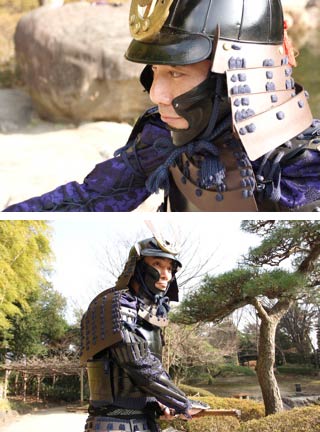
Having dressed himself in typical kobakama (pants) and kosode (small-sleeved under shirt), the Samurai first starts putting on his armour from the bottom, starting with the left side and working his way upwards. While it was possible for a Samurai to put on armour by himself, it was usual to have an assistant help him.
Step 1) First the Samurai put on the suneate (shinguards) starting with the left first. The suneate have vertical iron plates connected by chain mail and sewn onto a cloth backing. For high-ranking and middle-ranking Samurai there are leather pads on the inside of the calf for protection from the stirrups when riding. The cords are tied at the front or the outside to avoid them rubbing together.
Step 2) Next the samurai put on the upper leg protectors or haidate. The haidate is an apron-like piece of cloth covered with small overlapping plates of iron. It is tied at the front so that it can be easily and quickly removed. The haidate was removed when fighting on boats or in the water.
Step 3) The next item is the kote, which are armoured sleeves. These are silk brocade covered in iron plates and chain mail to protect the arms and the back of the hands. He starts with the left and ties it before putting on the right. He ties each one over the shoulder. The wrist is tied by winding the two cords around. The right kote was removed when shooting arrows.
Step 4) The actual body armour is put on next. The body armour of tosei gusoku, okegawa do style consists of a breast plate and back plate (nimai do) both with a laminated iron skirt (kusazuri) to further protect the legs and waist. The okegawa do has a hinge on the left side. To put it on the Samurai opened the do (body armour) at the hikiawase (opening) and put his left arm in first and placed the shoulder pads on his shoulders. He then closed the hikiawase and tied it closed with the cord called a takahimo. It is tied so that it can be removed quickly. At the shoulder pads there are toggles (kohaze) which support the breast plate. When crossing water or sneaking about at night, the kusazuri could be tied up by passing a single long cord through the last of each plate and tying them up over the shoulders.
Step 5) Next, the Samurai put on the sode or shoulder protectors. They are suspended from the do by kohaze toggles. These could be removed in a hurry when climbing tall obstacles.
Step 6) The next step is to put on the uwa-obi or sash for holding the swords. It is tied around the waist over the suspension cords (yurugi no ito) for the kusazuri (laminated iron skirt). It is wound two or three times around the waist and tied at the front slightly to the right. It was customary to wear a white uwa-obi in which case it was referred to as a hakubutai. The uwa-obi is made from linen or cotton.
Step 7) The next step is to insert the short sword uchi-gatana or tanto into the uwa-obi at the front and to then tie the tachi into place at the left side. (This step and an explanation of the swords carried while a Samurai was in armour are in our video on Japanese swords.)
Step 8) The hoate or face protector is put on next. The hoate in our video has a full nose piece and moustache and so it is called a mempo. The face protector is tied at the top of the head slightly towards the back and suspension hooks on the sides are attached to the helmet cords to further hold it up. The hoate were omitted in furious fighting or during night combat.
Step 9) The last item is the helmet or kabuto. The helmet consists of an iron bowl made from vertical plates with a hole at the top which was used in older times to pass the top-knot of hair through. It was retained in later armour for ventilation. It has a neck guard (shikoro) at the back and sides to protect the neck and a visor across the front (mabisashi) to protect the face and eyes. There were hundreds of different styles of kabuto and this is the one item where the samurai went to great lengths to distinguish himself on the battlefield. Kabuto were adorned with elaborate crests (maedate) which were more often than not the family crest. Kabuto could also have detailed sculptural objects representing animals, mythical beings, prayers or other symbols. The most commonly seen were horns of a various types and sizes.